What Is the African Union? History, Aims, Organs and Members
The African Union brings together the states of Africa in one continental organisation. Here is where it came from, what its founding treaty commits members to, and how its Assembly, Commission, councils and courts fit together.
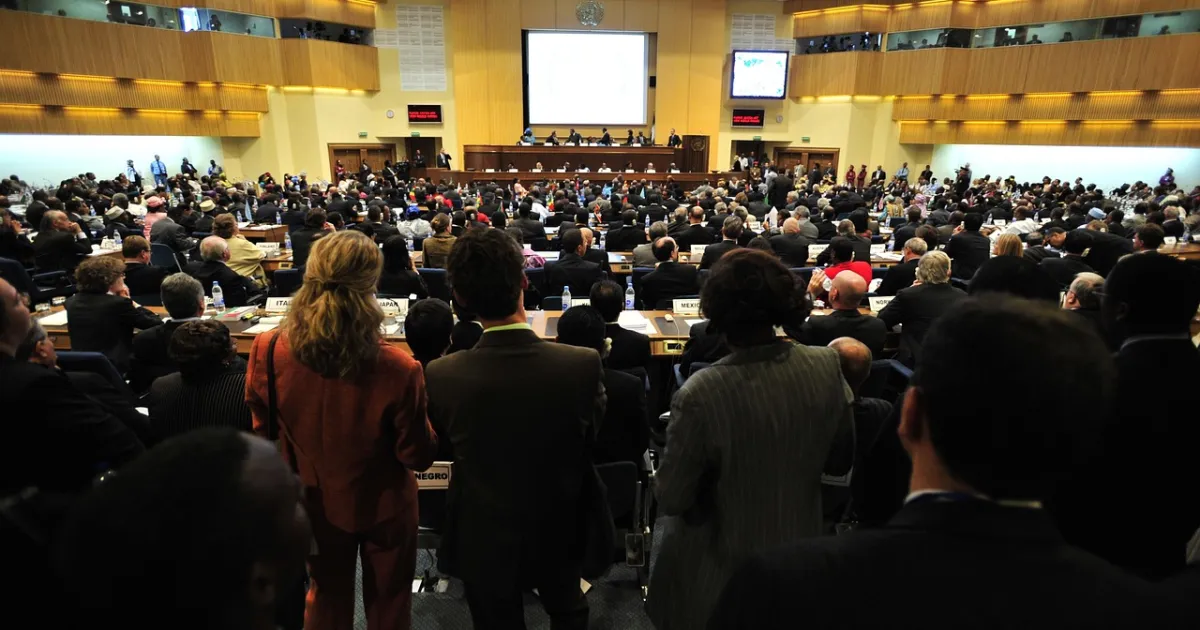
The African Union (AU) is the continental organisation of African states. It was launched in Durban, South Africa, on 9 July 2002 as the successor to the Organisation of African Unity (OAU), and its headquarters are in Addis Ababa, Ethiopia. The AU's own website gives its membership as 55 member states. Its founding treaty, the Constitutive Act, commits members to unity, peace and development, and also to democratic principles, human rights and good governance.
The AU describes its vision as "an integrated, prosperous and peaceful Africa, driven by its own citizens". In practice it is a forum where governments agree common positions, a set of institutions that carry out those decisions, and a framework of treaties on subjects from human rights to elections.
From the OAU to the African Union
The AU's predecessor, the Organisation of African Unity, was founded in May 1963, when the heads of 32 independent African states met in Addis Ababa to sign its Charter. The preamble of the AU's Constitutive Act credits the OAU with a "determining and invaluable role" in the liberation of the continent.
By the late 1990s African leaders wanted a stronger body. The main steps were:
- 9 September 1999: at an extraordinary summit in Sirte, Libya, OAU heads of state and government issued the Sirte Declaration, deciding to establish an African Union.
- 11 July 2000: the Constitutive Act of the African Union was adopted at Lomé, Togo.
- 26 May 2001: the Act entered into force after two-thirds of OAU member states had ratified it.
- 9 July 2002: the AU was launched in Durban, and the OAU was disbanded the same day.
The Constitutive Act formally replaced the OAU Charter, although the Charter stayed operative for a transitional period so that the OAU's assets and liabilities could be handed over.
What the AU is for
Article 3 of the Constitutive Act lists the Union's objectives. They include:
- greater unity and solidarity between African countries and peoples;
- defending the sovereignty, territorial integrity and independence of member states;
- speeding up the political and socio-economic integration of the continent;
- promoting peace, security and stability;
- promoting democratic principles and institutions, popular participation and good governance;
- promoting and protecting human and peoples' rights in line with the African Charter on Human and Peoples' Rights;
- sustainable development and the integration of African economies.
Article 4 sets out the principles the Union works by. Two of them pull in different directions and are often discussed together. One is non-interference by any member state in the internal affairs of another. The other is the right of the Union itself to intervene in a member state, by decision of the Assembly, in "grave circumstances, namely: war crimes, genocide and crimes against humanity". Article 4 also lists respect for democratic principles, human rights, the rule of law and good governance, and the "condemnation and rejection of unconstitutional changes of governments".
The main organs
The Constitutive Act creates a set of organs, and the Assembly may add others. The table summarises the ones most often in the news.
| Organ | Who sits on it | What it does |
|---|---|---|
| Assembly | Heads of state and government | The supreme organ. Sets common policy, adopts the budget, considers membership applications and appoints the Commission. Meets at least once a year; its chair is held for one year. |
| Executive Council | Foreign ministers or other ministers designated by governments | Co-ordinates policy in areas such as trade, energy, agriculture, transport, education and health. Answers to the Assembly and meets at least twice a year. |
| Commission | A Chairperson, deputy or deputies, and Commissioners | The Union's secretariat, based in Addis Ababa. Prepares and carries out the Union's work day to day. |
| Permanent Representatives Committee | Member states' permanent representatives to the Union | Prepares the work of the Executive Council and acts on its instructions. |
| Peace and Security Council | Fifteen member states, elected to reflect Africa's regions | Takes on peace-making and peace-building to resolve conflicts, and can recommend intervention to the Assembly in grave circumstances. |
| Pan-African Parliament | Members chosen by national parliaments | A continental assembly for debate and consultation, based in Midrand, South Africa. |
| Economic, Social and Cultural Council | Social and professional groups from member states | An advisory organ giving civil society a formal voice. |
The Peace and Security Council was set up under a protocol adopted in July 2002. Ten of its members are elected for two years and five for three years. The Pan-African Parliament has its own explainer: what the Pan-African Parliament does.
How decisions are taken
Both the Assembly and the Executive Council decide by consensus or, failing that, by a two-thirds majority of member states. Procedural questions need only a simple majority, and two-thirds of the membership forms a quorum. The Act names its working languages as, "if possible", African languages, Arabic, English, French and Portuguese.
Courts, rights bodies and financial institutions
The Constitutive Act provides for a Court of Justice of the Union, and the AU lists a group of judicial and human rights organs, including the African Commission on Human and Peoples' Rights in Banjul, The Gambia, and the African Court on Human and Peoples' Rights. The Act also provides for three financial institutions: an African Central Bank, an African Monetary Fund and an African Investment Bank. The AU describes these as planned rather than operating.
Membership, sanctions and suspension
Any African state may apply to join. Admission is decided by a simple majority of member states. A state that wants to leave must give written notice, and it stops being a member one year later unless it withdraws the notice. Morocco was admitted on 31 January 2017.
The Act gives the Union two kinds of pressure on members:
- Sanctions. A member that falls behind on its budget contributions can be denied the right to speak or vote at meetings, or to put forward candidates for posts. A member that fails to comply with the Union's decisions can face other political and economic measures decided by the Assembly.
- Suspension. Article 30 says that governments which "come to power through unconstitutional means" shall not be allowed to take part in the activities of the Union.
The African Charter on Democracy, Elections and Governance spells out what counts as an unconstitutional change of government and gives the Peace and Security Council the job of suspending a state party when one occurs. Which countries are suspended at any moment changes as situations develop, so the current list is best checked against the AU's own announcements.
Why the AU matters for elections and democracy
The AU is not a government and cannot run elections in its member states. Its influence comes through the standards members have signed up to, the observer missions its Commission sends to national elections, and the political weight of suspension. For voters, the most visible sign of the AU is often an AU election observation mission, whose statements and reports assess an election against those shared standards.
Common questions
How many countries are in the African Union?
The AU's website gives its membership as 55 member states (checked November 2026). Some members may be suspended at a given time, which limits their participation without ending their membership.
Where is the African Union's headquarters?
In Addis Ababa, Ethiopia, as set out in Article 24 of the Constitutive Act. Some organs sit elsewhere, such as the Pan-African Parliament in Midrand, South Africa.
What is the difference between the OAU and the African Union?
The OAU, founded in 1963, was replaced by the AU in 2002. The AU's Constitutive Act added new organs, a right to intervene in cases of genocide, war crimes and crimes against humanity, and an explicit rejection of unconstitutional changes of government.
Can the African Union suspend a member state?
Yes. Under Article 30 of the Constitutive Act, governments that come to power through unconstitutional means are barred from taking part in the Union's activities. Members can also be sanctioned for unpaid contributions or for ignoring the Union's decisions.
Sources
The Ballot Primer is independent and non-partisan. Spotted an error? Tell us.
Keep reading

What Is SADC? The Southern African Development Community Explained
SADC links 16 countries of southern Africa in a community for development, trade and security co-operation. Here is how it began,…
9 November 2026
The Pan-African Parliament: What It Is, Who Sits in It and What It Can Do
The Pan-African Parliament is the African Union's continental assembly. Its members come from national parliaments and its powers…
9 November 2026

How Election Observation Works: Observers, Missions and Reports
Election observers watch the whole electoral process, not just polling day, and report on how far it met agreed standards. Here i…
9 November 2026